


Presentation
Casa Sollievo della Sofferenza, the hospital in San Giovanni Rotondo dreamt up by Padre Pio and inaugurated in 1956, is now a leading institution in healthcare, recognized both nationally and internationally, and known worldwide as Padre Pio’s Hospital.
Situated just a short distance from the Capuchin Friars’ Convent, where Saint Pio of Pietrelcina lived and died, the hospital spans an extensive area of approximately 100,000 square meters. Its facilities include the main hospital complex, featuring the monumental building with its white stone facade, the "Giovanni Paolo II" Outpatient Clinic, and the ISBReMIT Research Center
In addition to the healthcare hub in San Giovanni Rotondo, the institution runs other facilities, including dialysis centers in Manfredonia, Rodi Garganico, and Vieste, as well as the Casa Sollievo della Sofferenza - Mendel Institute in Rome. This research institute, founded in 1953 by geneticist Luigi Gedda, was acquired through donation in 1998 by the Casa Sollievo della Sofferenza Foundation.
The hospital is managed under the auspices of the Italian National Health Service as a classified religious hospital with a high level of specialization. It is officially recognized as a Scientific Institute for Research, Hospitalization, and Healthcare (IRCCS) by decree of the Ministries of Health and University and Scientific Research dated July 16, 1991.
In addition to delivering clinical and healthcare services, the hospital is actively involved in clinical research in close collaboration with the Ministry of Health and leading research centers across Italy and Europe. Its research efforts have traditionally focused on genetics and hereditary diseases, an area that was officially expanded on December 5, 2012, from “Genetic and Hereditary Diseases” to include “Genetic Diseases, Innovative Therapies, and Regenerative Medicine.”
With the introduction of the Italian Legislative Decree of 23 December 2022 n. 200 on the Reorganization of Italian Research Hospitals and, consequentially, with the Decree of the Italian Ministry of Health of 23 October 2023, the Casa Sollievo della Sofferenza is recognized a Research Hospital for the thematic areas of Oncology, Neurology and Diagnosis.
This recognition as a scientific institute represents the fulfillment of the vision of its Founder, who had the foresight more than 60 years ago to envision research as an integral component of the professional commitment of physicians—particularly those at Casa Sollievo della Sofferenza—and as a vital contributor to scientific progress.
Today, research activities are carried out at the "Giovanni Paolo II" Outpatient Complex, within the laboratories of the Casa Sollievo della Sofferenza - Mendel Institute in Rome, and at the ISBReMIT Research Center (Institute for Stem-cell Biology, Regenerative Medicine, and Innovative Therapies). This cutting-edge facility integrates the research previously conducted in San Giovanni Rotondo while introducing a state-of-the-art laboratory for the production of stem cells for clinical use—one of the few such facilities in Italy.
The hospital is part of the Casa Sollievo della Sofferenza Foundation, which also oversees other institutions that reflect Padre Pio’s vision of combining love and science:
- The "Giovanni Paolo II" Outpatient Clinic"
- The ISBReMIT Research Center (Institute for Stem-cell Biology, Regenerative Medicine, and Innovative Therapies);
- The CSS-Mendel Institute in Rome;
- Casa Zeni, which provides accommodation for patients and families of children hospitalized in the Pediatric Oncology Department;
- The Santa Maria della Grazie Hospitality Center Casa Abresch, and the Spirituality Center - Cenacolo Santa Chiara, which offer hospitality and spiritual guidance;
- The Casa Padre Pio Elderly Residence, encompassing an RSSA facility for elderly individuals who lack self-sufficiency, a retirement home, and supported living accommodations.
It is also worth highlighting Masseria Calderoso and the Posta La Via Agro-Livestock Farm, two agricultural enterprises donated to Padre Pio by benefactors. These farms now provide food products for the hospital and are managed by Immobiliare Casa Sollievo della Sofferenza, established in 1946 by Padre Pio’s earliest collaborators to create a legal framework for the ambitious project that was beginning to take shape.
Inaugurated in the 1950s, Casa Sollievo della Sofferenza has evolved into a modern healthcare facility, structured according to the latest principles of healthcare management and equipped with cutting-edge technologies.
Described by Padre Pio as “the structure that will defy the centuries,” it was originally designed to address the healthcare needs of the Gargano region. Over the years, it has grown into a complex and multifaceted organization with a significant national and international presence.
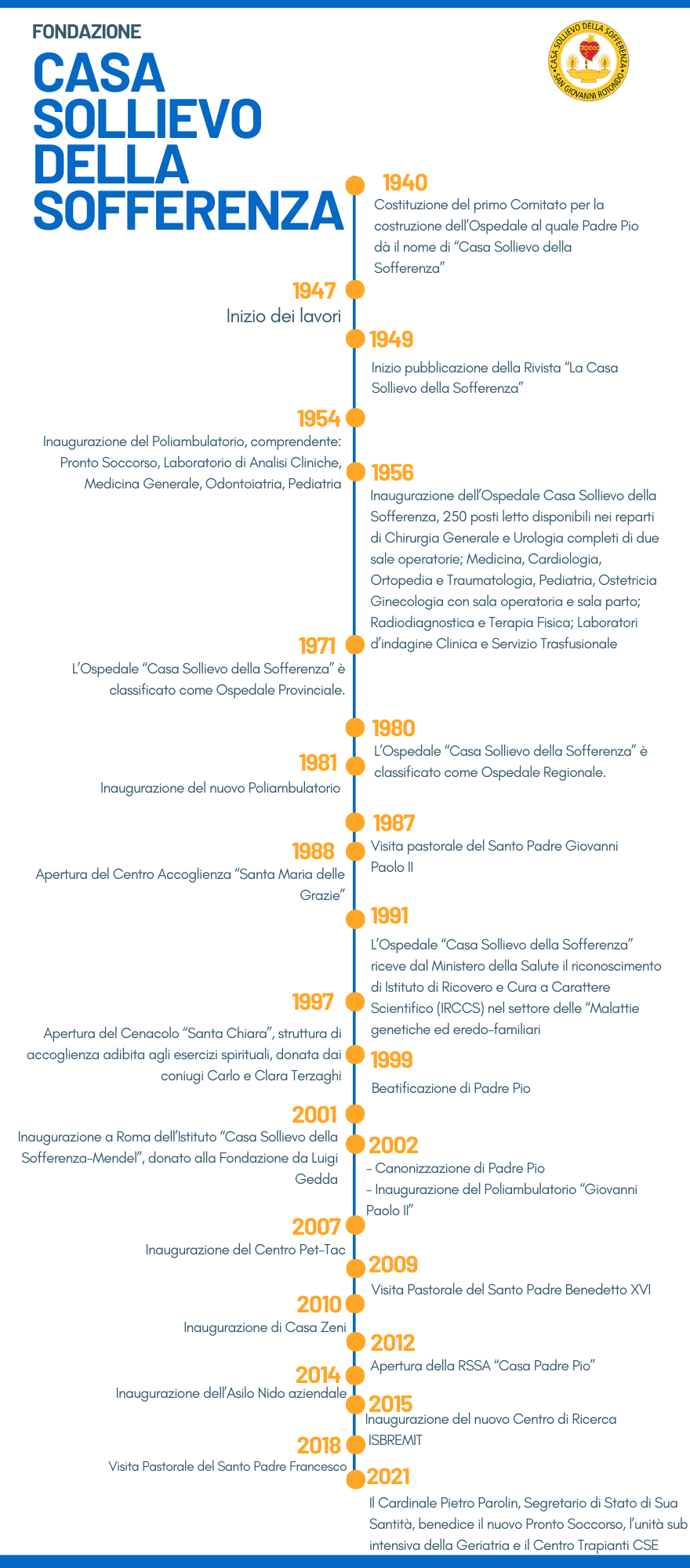
History
In 1916, Padre Pio, a Capuchin friar from the monastic province based in Foggia, arrived in San Giovanni Rotondo seeking relief from his poor health. He found a secluded hermitage surrounded by untouched, desolate nature and a small village in the valley below, entirely lacking in healthcare services aside from the efforts of the diligent local physicians.
Two years later, the striking manifestation of the stigmata and the subsequent massive influx of pilgrims brought Padre Pio face to face with the immense suffering of the local populations in the Gargano region and neighboring areas, where people afflicted with various illnesses turned to him, appealing for help as a man of God. He was particularly moved by the plight of those living in the remote villages of the Gargano promontory who needed hospital care or specialized treatments, which were only available in Foggia. Reaching Foggia at the time was an arduous journey due to the poor infrastructure and transportation options.
Padre Pio began envisioning a solution to address the healthcare needs of the sick, at least within the village of San Giovanni Rotondo, his charitable efforts leading to the creation of the "Ospedale Civile San Francesco," a modest hospital with limited bed capacity but equipped with two operating rooms. Unfortunately, this initiative failed shortly after its inception due to a lack of proper management and a series of adverse events, including the 1938 earthquake that nearly destroyed the former convent housing the small hospital. Meanwhile, Padre Pio's original vision of providing "relief from suffering" began to take form as a more comprehensive plan: the creation of a new hospital near the convent, Casa Sollievo della Sofferenza, where medical care for the body would be seamlessly integrated with spiritual healing.
It was founded in words and written notes on January 10, 1940, in Padre Pio’s cell, alongside some of his spiritual children: Guglielmo Sanguinetti, Mario Sanvico, Carlo Kisvarday, John Telfener, Ida Seitz, Angela Serritelli, and Cleonice Morcaldi. This small group of devoted followers, guided, encouraged, and inspired by Padre Pio, embarked on the challenging path of realizing his vision, fueled by their profound faith in Divine Providence. With an initial fund of just four million lire, construction began shortly after a forced suspension due to the war, based on the design by Angelo Lupi—a man of extraordinary creativity from Abruzzo who, though neither an engineer nor a surveyor, developed a plan that resonated deeply with Padre Pio. He selected the design and personally identified the mountain as the site where the hospital, then referred to as a "clinic," would rise.
Construction required extensive excavation of the rugged Gargano rock, employing hundreds of workers, many of whom were war veterans returning from the fields. They were inspired by the desire to contribute to what was perceived as a gift of Providence, born from Padre Pio’s spirituality and profound commitment to charity. Alongside the hospital, the Prayer Groups were established to support this Christian mission of relieving suffering. This global, lay-spiritual movement, rooted in intercessory prayer, continues to embody its foundational charism.
Casa Sollievo della Sofferenza opened on May 5, 1956, as a private clinic with 250 beds, offering essential medical services in surgery, internal medicine, obstetrics and gynecology, pediatrics, radiology, clinical laboratories, orthopedics, and outpatient care. From that moment on, the hospital and the Prayer Groups have been at the heart of a development program inspired by the principles and vision outlined by Padre Pio in his speeches during various commemorations of the institution. Over time, and with the support of the Holy See, to whom Padre Pio entrusted his work, this program has expanded to include numerous activities and initiatives aimed at supporting patients, their families, the elderly, and those in need.
Mission and Values
“This Work, if it were only to relieve physical suffering, would merely be the creation of a model clinic supported by your extraordinarily generous charity. But it is meant to be much more—a living testament to God’s love, brought to life through the practice of charity. Within it the suffering must experience the love of God through the wise acceptance of their pain and the serene contemplation of their destiny in Him. In this Work, love for God must be nurtured in the patient’s soul through the love for the Crucified Jesus, radiating from those who care for the infirmity of both body and spirit.” (Padre Pio, May 5, 1957 - Anniversary Address of the Hospital)
Casa Sollievo della Sofferenza is a state-of-the-art hospital designed to address diagnostic and therapeutic needs through a healthcare system of the highest standard, managed by a team of exceptionally skilled and deeply committed professionals. Its technological, professional, and organizational resources represent the pinnacle of modern healthcare, making it one of the most prestigious medical institutions in Italy (Newsweek Banner, 2021).
Yet, the mission entrusted to us by Saint Pio of Pietrelcina transcends care of the body. The Founder’s vision was not merely to create a “hospital” in the conventional sense. He envisioned a “House”—a “Place of Prayer and Science” where “patients, physicians, and priests serve as reservoirs of love, with each one’s abundance flowing to enrich others.”
This institution was conceived to reflect Padre Pio’s vision of relieving suffering: a House where the most advanced medical technologies and expertise are united with the spirit and compassion of Jesus Christ. Here, every member of the staff is called upon daily to embody a mission of active and heartfelt service to those who suffer.
To the physicians, Padre Pio often said: “Your mission is to heal the sick, but if you do not bring love to the bedside, I do not believe medicine alone will be of much help. Bring God to the sick—it will be worth more than any treatment.”
In line with the principles that inspired Padre Pio to establish Casa Sollievo, the work of this hospital remains steadfast in providing care to those in need, marked by excellence, profound humanity, and unwavering Christian charity.
Services at Casa Sollievo, which began in 1956 with inpatient care in the core disciplines of general surgery and internal medicine, alongside the foundational specialties of pediatrics and obstetrics-gynecology, have evolved progressively to encompass all major medical, surgical, rehabilitative, and diagnostic specialties.
Today, healthcare delivery is structured around a departmental model, adhering to the most advanced standards of hospital clinical organization. This reorganization represents a significant departure from traditional approaches to clinical care and the doctor-patient relationship. The older framework, often reflected in terminology such as "ward," "section," or "division," underscored a fragmented view of healthcare services and the conditions treated, removed from the holistic context of the patient as a person. Currently, medical, surgical, and diagnostic units are integrated within the same department when they share a focus on a specific organ or system, fostering a more cohesive and patient-centered approach to care.
The ongoing commitment to the training and professional development of healthcare personnel is demonstrated by the hospital's recognition as one of the leading Continuing Medical Education (CME) providers in the Puglia Region, based on the number of courses organized.
Over the years, we have forged relationships with universities and the academic community through agreements and partnerships with various universities and medical specialization schools. The Casa Sollievo della Sofferenza - Mendel Institute serves as a teaching hub for physicians and biologists, hosting the Medical Genetics specialization program within the Faculty of Medicine and Surgery at the University of Rome La Sapienza. Many of our specialists are directly involved in academia, serving as university faculty members.
In the early years of the hospital, a Professional Nursing School was established, later expanded to include a Midwifery School. Today, the Nursing School has evolved into the Bachelor of Science in Nursing, offered by the Faculty of Medicine and Surgery at the University of Foggia.