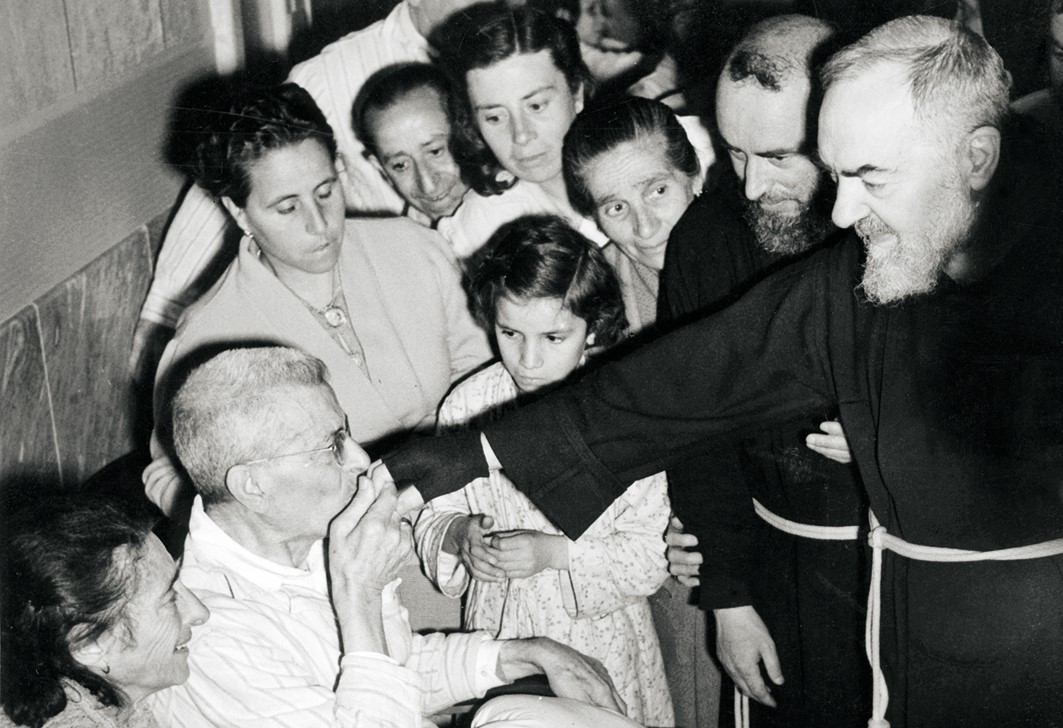
New Sorrows: Illness
Padre Pio’s long-cherished dream had finally come to life. The relief of physical suffering had begun under the most favorable conditions. Esteemed clinicians selected the hospital’s department heads from among their most talented protégés, and the staff was meticulously chosen.
Before long, the hospital reached full capacity across all its wards. Just a year after its inauguration, discussions about expansion were already underway, outlined by Padre Pio himself in his address commemorating the first anniversary of its opening.
Life within and around the hospital flourished. The energy it generated spurred a noticeable increase in private initiatives. The presence of the hospital, with its constant activity, brought about a transformation of the entire area surrounding the friary, as well as the town itself, as both adapted to meet the demands of the new reality.
Everything seemed to be progressing seamlessly. Even the legal framework of the hospital—an issue that had caused great concern for its leaders from the very beginning—appeared to have reached a remarkable resolution. A singular provision granted Padre Pio full authority as both the owner and administrator of the institution. This extraordinary arrangement freed him—a son of Saint Francis—from his vows of poverty and obedience, but solely for the purpose of enabling him to fulfill the mission of overseeing his work.
This extraordinary concession, granted by Pope Pius XII—who had always held Padre Pio in the highest esteem—was a remarkable testament to the saint’s mission. Yet, just two years later, in May 1959, a month filled with bustling activity and new initiatives, Padre Pio fell seriously ill. His condition deteriorated to the point that he could no longer come down to hear confessions or celebrate Mass, sparking grave concerns for his life.
The anguish among his spiritual children was profound, as they faced the prospect of losing his presence and guidance.
Padre Pio sought to comfort them as best he could, delivering brief daily exhortations from a microphone in his cell, which were broadcast to the church and the square outside through loudspeakers.
Then, his health took a sudden turn for the better, immediately following the visit to San Giovanni Rotondo of the Pilgrim Madonna of Fatima during her tour of Italy.
Padre Pio openly attributed his recovery to her intercession. He resumed celebrating Mass in public and hearing confessions, although his schedule was now greatly reduced compared to earlier years.
New Sorrows: Another Apostolic Visitation
As if his physical suffering were not enough, a new storm began to gather around Padre Pio.
This time, it involved a significant number of individuals close to him, including members of his own Order and even some of his spiritual children.
From the spring of 1960 onward, a wave of inspections and covert investigations unfolded, eventually culminating in an official apostolic visitation. Monsignor Carlo Maccari, sent by the Holy See, arrived to conduct a thorough inquiry. Over the course of nearly two months, he meticulously examined every aspect of Padre Pio’s life, scrutinizing both people and circumstances, before presenting his findings to Pope John XXIII.
The results of the investigation soon became apparent. Harsh measures were imposed on Padre Pio—not as a critique of his priestly character, but of his role as a spiritual guide. In essence, these measures sought to isolate him, drastically limiting and curtailing his usual interactions with the faithful.
For Padre Pio, this was a profound mortification. He had always seen himself as the true spiritual father to all who placed their trust in him.
The strain undoubtedly took a toll on his health, which began to decline noticeably. He eventually needed a wheelchair to navigate his usual paths and had to celebrate Mass while seated.
Day and night, he was accompanied and lovingly cared for.
Even the ascent of Pope Paul VI to the chair of Saint Peter—a pope who openly admired Padre Pio—brought little tangible relief.
Although the restrictions were eased as much as possible by superiors and confreres who loved him deeply and tended to him with devotion, the measures had to remain in place. Meanwhile, his following continued to grow, and expressions of admiration multiplied, including from prominent figures within the Church itself.