Restrictive Measures from the Holy See
Padre Pio found himself not only at the center of the fervor unintentionally stirred among the crowds by the miraculous phenomena appearing on his body but also embroiled in sharp controversies and disputes surrounding his character as a religious figure.
His reputation was called into question—sometimes through outright slander—especially by certain members of the local clergy affiliated with the Diocese of Manfredonia. Among them was a bishop who harbored little goodwill toward Padre Pio and painted him in an unfavorable light before the Holy See.
At the same time, Padre Pio’s supporters responded with equal intensity. They defended him fiercely, countering the defamatory accusations with explosive dossiers aimed at discrediting his detractors. In some instances, their support even led to public demonstrations. These tensions escalated as the Holy See began issuing measures regarding Padre Pio. At first, the Holy See merely declared that the phenomena associated with him were not of supernatural origin and repeatedly discouraged people from visiting him. Then, in 1931, stricter measures were imposed. Padre Pio was confined within the cloister of the friary and prohibited from hearing confessions, celebrating Mass in public, maintaining his correspondence, or having any contact with the faithful.
During this period of what was effectively imprisonment, Padre Pio celebrated Mass in a small private chapel and interacted only with his fellow friars and a few trusted visitors.
Tensions reached a boiling point when rumors began circulating that Padre Pio was about to be transferred. An angry crowd stormed the friary, putting the individual allegedly tasked with carrying out the transfer order in serious danger.
Whether the transfer order was real or not, the townspeople of San Giovanni Rotondo took action. They organized a round-the-clock watch over the friary, maintaining shifts day and night to guard its grounds.
Padre Pio Freed
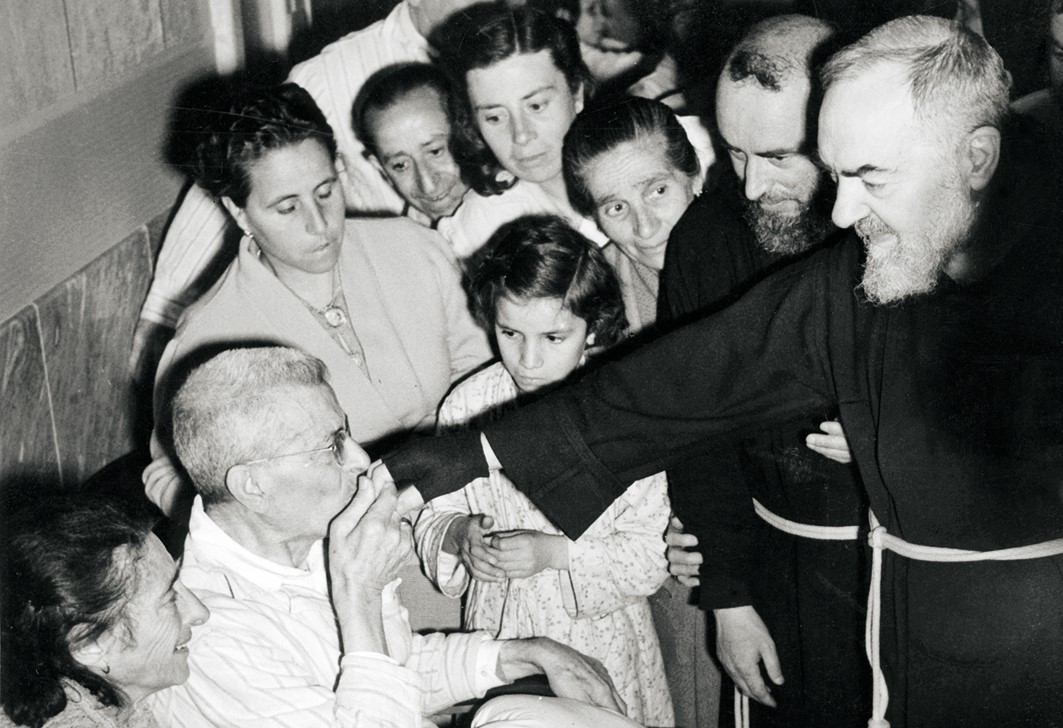
The strict confinement lasted for nearly two years. Finally, in June 1933, Padre Pio was granted permission to once again celebrate Mass in public and hear confessions. While the Holy Office may not have fully changed its opinion of him, it had at least affirmed his integrity as a religious figure, which was a significant step forward. With the storm behind him, Padre Pio resumed his public ministry, reconnecting with the faithful and guiding souls with greater tranquility. However, he was still prohibited from engaging in the extensive correspondence he had maintained in the past.
Despite this limitation, his spiritual children multiplied, spreading across virtually every region. Many traveled regularly to San Giovanni Rotondo, staying for days or even weeks to be near him. At that time, the town remained untouched by modern progress. It preserved a way of life that was simple and authentic, steeped in tradition and original customs. Visitors were welcomed into the homes of local residents with a warmth and sincerity that reflected the fraternal spirit of the community. Back then, no buildings stood between the friary and the town—just open countryside. The road connecting them was little more than a rugged mule track, steep and uneven, traversed on foot or by carts. These carts hauled gravel and sand from the quarries behind the friary or carried goods in covered wagons pulled by horses from the surrounding villages. Automobiles were a rare sight, and their occasional appearance—a visitor of note, perhaps—was an event in itself, as they struggled to navigate the rough terrain.